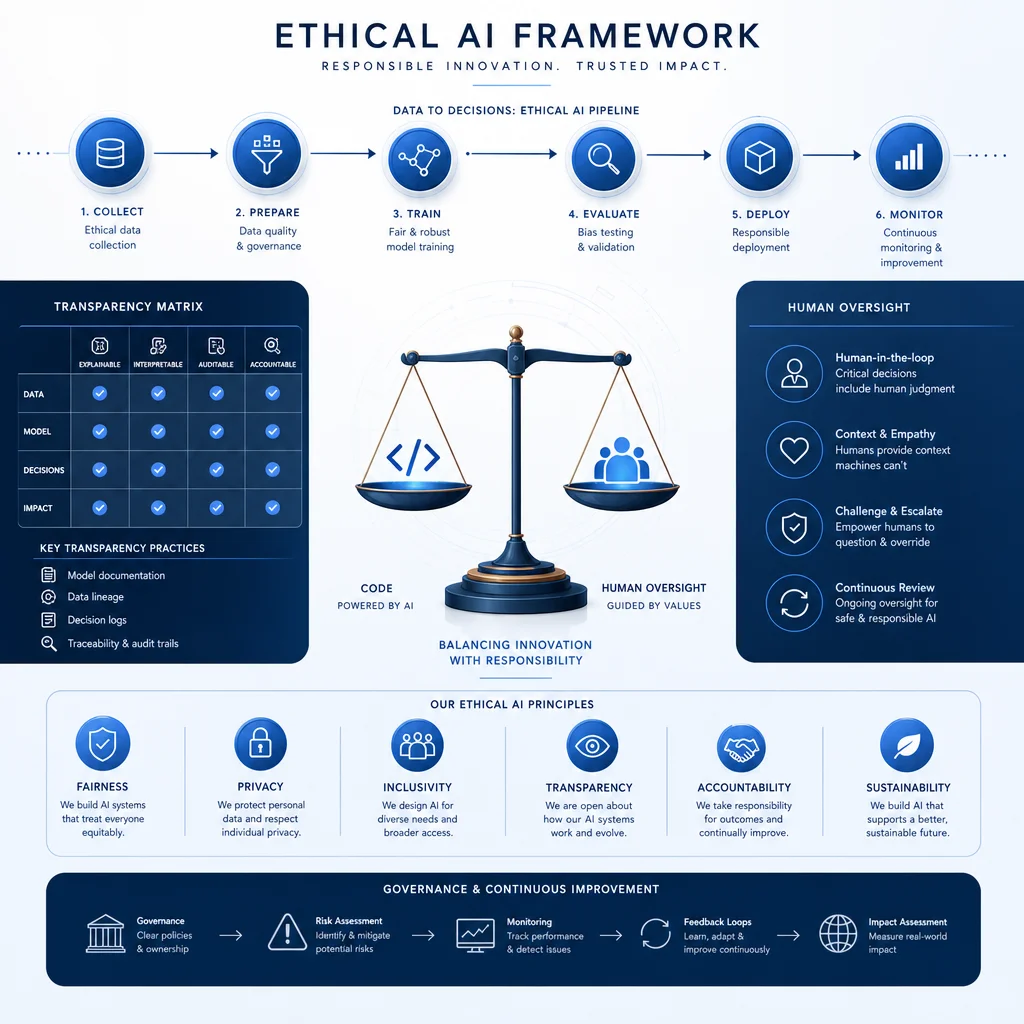
Why Ethical Standards Matter More Than Ever
Artificial intelligence has quietly transitioned from research laboratories into the machinery of everyday decision-making: determining loan eligibility, screening job candidates, assisting clinical diagnoses, and shaping real-time digital experiences. Every single one of these moments is dictated by choices made long before a neural network sees production traffic. Ethical standards cannot function as a superficial compliance checkbox bolted onto a project right before launch. Instead, they represent a rigorous design discipline spanning the entire lifecycle—from the architecture of the initial data pipeline to post-deployment monitoring dashboards. Organizations that treat ethics as an afterthought invariably pay a compounding technical and reputational debt: biased outputs, sudden regulatory scrutiny, eroded user trust, and costly emergency rewrites that could have been prevented through proactive governance.
Ethics Begins in the Data Pipeline
Long before hyperparameters are tuned or loss functions are optimized, engineers make foundational choices about data acquisition, sourcing, and filtering. These unglamorous data engineering decisions carry far more ethical weight than abstract debates over model architecture. A training dataset that inherently over-indexes on specific languages, geographic regions, or demographic groups quietly instructs the model that those populations represent the baseline, rendering everyone else an anomaly. No downstream cleaning library or algorithmic debiasing trick can fully mend a fundamentally skewed foundation. True data ethics demands upfront documentation and rigorous methodology from day one:
- Maintain immutable provenance records for every data source, logging collection dates, ownership, licensing terms, and consent parameters.
- Explicitly document known structural gaps, such as underrepresented dialects, age brackets, or socioeconomic tiers.
- Maintain a comprehensive audit trail of every data removal, imputation, and correction so that the dataset can be deterministically reconstructed.
Consent, Purpose, and the Limits of Publicly Available Data
A pervasive myth in modern machine learning dictates that data accessible via public web scraping is automatically fair game for model ingestion. In reality, harvesting public forum posts or social media profiles for commercial training often violates the reasonable privacy expectations of the original creators. Consent is not merely a legalistic box to check; it is an ethical litmus test regarding whether a data contributor would willingly endorse the use case if explained transparently. A reliable heuristic for engineering teams is the “public disclosure test”: imagine publishing the complete source manifest alongside the final product. If that disclosure creates internal hesitation, the pipeline requires immediate structural revision. Purpose limitation is equally critical. Text collected strictly to optimize a spell-checking utility should not be repurposed silently to train automated psychological profiling models. Teams that map every dataset to a single, explicit, documented purpose find it vastly easier to defend their architecture when audited by regulators, journalists, or privacy-conscious users.
Bias Is Both a Data Problem and a Process Problem
Fairness discourse in AI frequently collapses into a counterproductive search for a single, mathematically flawless metric—a quest that is structurally doomed to fail. Algorithmic bias seeps into systems across multiple vectors: historical data inequities, flawed human labelling instructions, poorly designed objective functions, and biased product framing. For example, an automated hiring model trained on a decade of past corporate promotions will faithfully internalize and amplify the historical biases of that decade, penalizing non-traditional candidates. Simply scrubbing protected attributes like gender or race from the feature list offers zero protection, as proxy variables such as postal codes, academic institutions, and past job titles routinely encode the exact same discriminatory signals in disguise.
The pragmatic countermeasure requires a multi-layered verification protocol. Measure disparate impact and error rates across distinct demographic cohorts, rather than relying solely on global accuracy metrics. Audit the label creators and scrutinize their instructions for latent prejudice. Stress-test the model against counterfactual inputs—scenarios where all variables remain identical except for an irrelevant demographic marker. Crucially, integrate domain experts (such as HR professionals, sociologists, or clinicians) into the evaluation loop to intercept absurd correlations that purely statistical reviews overlook.
Transparency and Explainability in Practice
True transparency in machine learning does not mean dumping proprietary model weights or source code into the public domain. It means providing stakeholders with a truthful, intelligible account of system capabilities, operational boundaries, and the specific drivers behind individual decisions. For a credit-scoring model, this entails generating a clear feature-attribution report detailing why an application was rejected. For a content recommendation engine, it involves exposing the primary engagement signals driving the feed. The granularity of explanation must scale with the severity of the impact: a casual media playlist recommendation demands minimal explanation, whereas an algorithmic medical triage score requires exhaustive, verifiable interpretability.
- Explicitly notify users whenever they are interacting with an autonomous system rather than a human representative.
- Generate human-readable explanations highlighting the primary weight factors that influenced an individual decision.
- Publish comprehensive model cards detailing intended use cases, known operational limits, and subgroup performance evaluations.
Privacy by Design, Not by Patch
Catastrophic privacy failures in modern machine learning rarely stem from a single dramatic data breach; they emerge through incremental accumulation—a debug log here, an intermediate vector embedding there, an orphaned third-party analytics tracker left enabled. Data minimisation stands as the primary line of defense. If a specific data field is non-essential for the core objective, it must be excluded from the training corpus entirely. Where personal data is strictly mandatory, engineering teams should leverage differential privacy, secure multi-party computation, aggressive data aggregation, and minimal retention windows to mitigate exposure. Biometric markers, precise geolocation traces, and data collected from minors demand extreme architectural caution, as these categories are exceptionally sensitive and nearly impossible to truly anonymize. The golden rule for data hygiene: treat every stored training record as an impending liability and continually evaluate whether its continued existence is justifiable.
Accountability Demands a Named Owner
When an autonomous system inflicts real-world harm, the standard organizational reaction is a debilitating fog of diffusion of responsibility, where accountability is so fractionated that no single person owns the outcome. Robust ethical governance requires unambiguous, individual ownership at every stage of the lifecycle. Someone must personally sign off on the provenance of the dataset. Someone must validate the pre-release fairness metrics. Someone must serve as the direct escalation point when a user formally disputes an automated decision. These roles do not require massive bureaucracies, but they must be explicitly assigned and formally documented.
- Designate a named individual owner for every model deployed in production, replacing vague committee-based oversight.
- Maintain a cryptographic or version-controlled audit trail linking every model artifact directly to its training dataset and sign-off records.
- Define a clear, fast-track escalation protocol that connects aggrieved users to a human authority capable of overriding or pausing the system.
Testing for Fairness Before Release
Model evaluation is the crucible where ethical intentions meet empirical reality. Pre-release testing protocols must transcend aggregate accuracy scores, incorporating rigorous subgroup performance metrics, stress testing against adversarial prompts, and red-team simulations engineered to force system failure. Teams must also evaluate models against the foundational problem statements that initiated the project, as iterative optimization toward proxy metrics frequently causes dangerous drift from the actual human goal. Comprehensive documentation of untested edge cases is infinitely more valuable than an unblemished, vague performance summary, as it provides future maintainers with an honest assessment of structural risk.
Human Oversight at the Point of Deployment
A machine learning model that performs flawlessly in offline evaluation environments can still wreak havoc the moment it encounters live user behavior. Human-in-the-loop oversight serves as the final structural safeguard keeping automated decisions within acceptable ethical boundaries, but this mechanism fails entirely if it devolves into a decorative rubber stamp. A human reviewer forced to process two hundred complex cases an hour is not practicing governance; they possess only the illusion of control. Effective oversight requires manageable case volumes, absolute organizational authority to override algorithmic outputs, direct access to supporting contextual data, and protection against automation bias—the well-documented psychological tendency for humans to defer to confident machine outputs even when their own intuition signals an error. Restructuring workflows so that human reviewers evaluate raw evidence before seeing the model’s recommendation dramatically reduces confirmation bias.
Monitoring What Happens After Launch
Deploying a model into production is not the conclusion of its ethical lifecycle; it is merely the opening phase. Real-world data distributions constantly shift, societal behaviors evolve, and a model that demonstrated fairness in laboratory testing may exhibit severe disparate impact months later. Continuous production monitoring must actively track feature drift, subgroup outcome distributions, user complaint volumes, human override frequencies, and unexpected failure modes. Pre-configured alert thresholds should automatically trigger technical reviews rather than protracted debates over whether performance degradation is statistically significant. Furthermore, establishing frictionless feedback channels for affected individuals allows organizations to leverage end-user reports as real-time diagnostic data, recovering from systemic anomalies exponentially faster than competitors who treat complaints as noise.
The Regulatory Landscape Is Catching Up
Global regulatory frameworks are rapidly converging toward strict, risk-based compliance models. Emerging legislation classifies AI applications by their potential for societal harm, imposing stringent auditing obligations on high-risk deployments and mandating radical transparency toward affected citizens. Concurrently, sector-specific regulators in finance, healthcare, and employment are establishing explicit operational standards. For product and engineering teams, the strategic imperative is clear: assume that comprehensive documentation, bias testing evidence, and verifiable human oversight will soon be legally mandated, and embed these requirements into the workflow proactively. Building compliance as a natural byproduct of sound software engineering is cost-effective; attempting to retrofit governance under imminent regulatory deadlines is notoriously expensive and structurally incomplete.
An Ethical Checklist for Teams
- Map every data source and independently verify that its collection and ingestion are lawful, documented, and aligned with reasonable user expectations.
- Explicitly define the intended operational purpose and map out all vulnerable demographic populations potentially impacted prior to model training.
- Measure subgroup performance disparities and document known structural limitations alongside headline accuracy metrics.
- Designate a named human owner, maintain an explicit sign-off ledger, and establish a tested rollback protocol for every production model.
- Instrument live deployment environments with automated drift detection, fairness telemetry, and user grievance monitoring from day one.
The Bottom Line
Ethical standards in artificial intelligence are not achieved through high-minded corporate manifestos; they are forged through unglamorous, disciplined engineering habits: verifying data provenance, measuring who bears the cost of system errors, explicitly acknowledging what an algorithm cannot do, and keeping human judgment meaningfully embedded in the loop. None of these practices require sprawling ethics committees. They simply require development teams willing to pause at critical junctures and treat documentation as a core component of the software product rather than bureaucratic overhead. Organizations that internalize this discipline early ultimately ship faster and safer, spending significantly less time repairing trust they never intended to break.
“