Why Algorithmic Accountability Is a Board-Level Issue Now
Autonomous systems have moved out of research notebooks and into high-stakes operational environments: loan underwriting, claims triage, tenant screening, clinical routing, hiring funnels, fraud scoring and dynamic pricing. The moment an automated model starts shaping who gets credit, care, housing or employment, the foundational question changes from whether the algorithm works to whether you can prove it behaves lawfully, consistently and fairly. That operational shift defines algorithmic accountability in practice. It is neither a philosophical stance nor a public relations exercise. Instead, it is a rigorous operational discipline built on documented intent, measurable behavioral thresholds, traceable decision pathways and an audit trail that can withstand regulatory scrutiny or judicial review.
Most organizations discover the compliance gap the hard way. A machine learning model performs exceptionally well on aggregate validation metrics, deploys to production, and months later, a formal complaint arrives. When an auditor asks why a specific applicant was declined, internal teams scramble because nobody can accurately reconstruct the exact model version, feature weights, decision thresholds or human override logic that produced the outcome. The transactional data exists in the database, but the analytical narrative does not. Systematic auditing exists precisely to close that dangerous gap between a complex technical artifact and a legally defensible business decision.
What an Algorithm Audit Actually Examines
A credible audit of an autonomous system is never a single monolithic test. Rather, it is a structured, multi-layered examination spanning four distinct technical and operational domains. A system is only as accountable as its weakest structural layer.
1. The Data Layer
Auditors rigorously trace where the training data originated, what records were intentionally excluded, how target labels were assigned, and what specific population the dataset actually represents. They look for data provenance, explicit consent baselines, retention rules, and the quiet distortions introduced by survivorship bias or historical sampling skew. A model trained on three years of historically biased credit approvals will reproduce and accelerate that bias with mathematical precision.
2. The Model Layer
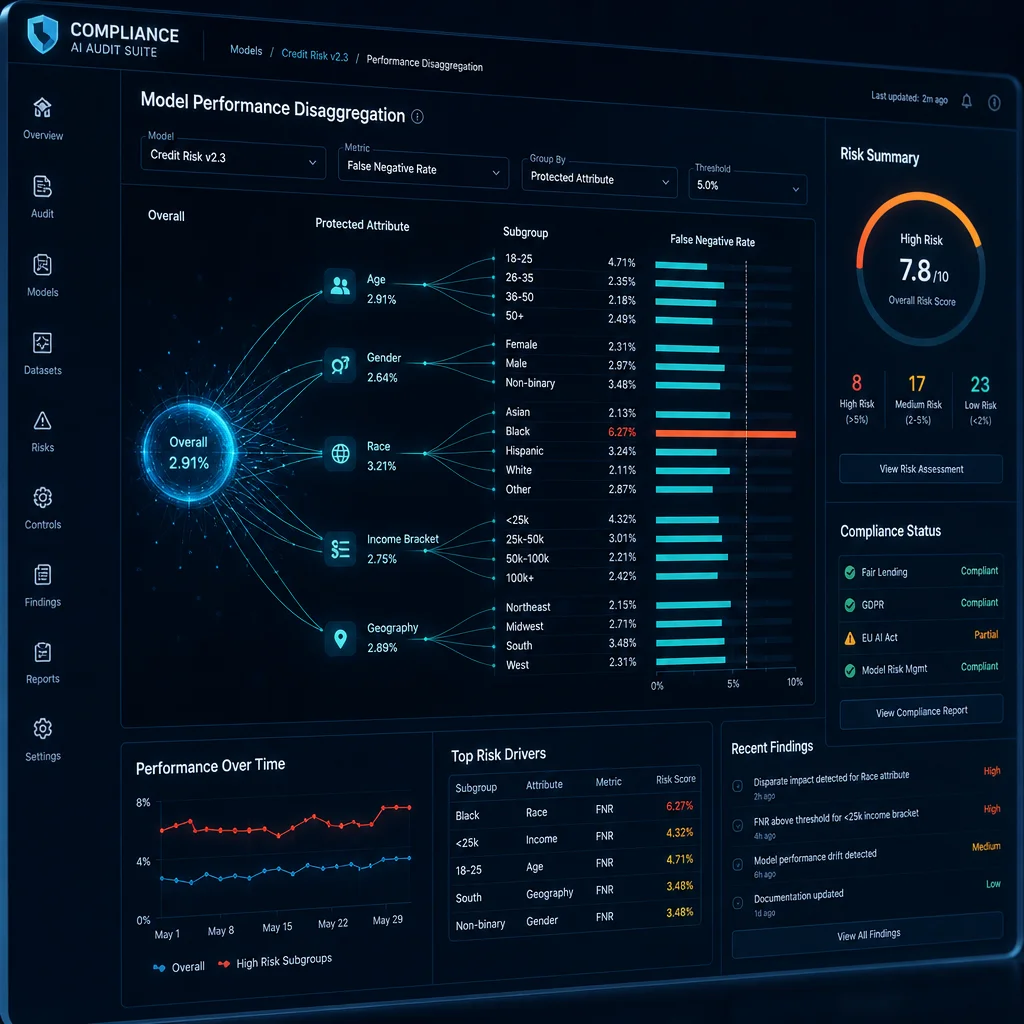
This layer covers architectural design choices, loss functions, decision thresholds, and disaggregated performance metrics across demographic subgroups rather than relying on an inflated overall accuracy score. An aggregate AUC of 0.86 tells you almost nothing about whether error rates diverge sharply between vulnerable segments and the general population. Auditors demand disaggregated performance metrics, calibration curves, and sensitivity analysis demonstrating how model outputs shift when specific input features fluctuate.
3. The Decision Layer
How does a probabilistic score translate into a concrete operational action? Who possesses the authority to override the system, and under what exact business conditions? Is there a genuine human-in-the-loop mechanism, or merely a rubber-stamping compliance queue where reviewers clear thousands of cases daily? Decision-layer auditing examines threshold configurations, formal appeal pathways, adverse-action notices, and whether the explanations provided to affected individuals are accurate rather than decorative or generic.
4. The Governance Layer
Even a technically pristine model will fail an audit if internal ownership is ambiguous or undocumented. Governance reviews map end-to-end accountability: who formally approves deployment, who continuously monitors drift, who owns incident escalation protocols, and how audit findings are remediated. Documented RACI matrices, strict version control, and comprehensive change logs serve as the definitive evidence that operational control is active rather than aspirational.
The Regulatory Backdrop Is No Longer Hypothetical
Compliance expectations have hardened at an unprecedented pace. The European Union Artificial Intelligence Act introduces tiered obligations tied directly to risk classifications, subjecting high-risk systems to strict mandates for risk management, robust data governance, detailed technical documentation, immutable logging, human oversight, and post-market monitoring. Simultaneously, data protection regulations grant enforceable rights regarding automated decision-making, including the right to meaningful information about the underlying logic.
Sector regulators in financial services and insurance now expect model risk management programs to expand beyond traditional quantitative models and fully encompass complex machine learning systems. In employment and lending sectors, long-standing anti-discrimination laws apply to algorithmic decisions just as they apply to human actors; enforcement agencies have made it explicitly clear that blaming the algorithm is never a valid legal defense.
The practical result is a convergence of global standards. Regardless of the operational jurisdiction, a credible accountability program requires a standardized core set of artifacts: a formal risk classification, a documented purpose and limitation statement, validated performance evidence, continuous monitoring records, and a named executive owner.
Building an Evidence Trail That Survives Scrutiny
Auditors evaluate hard records, never corporate intentions. Three core documentation artifacts carry disproportionate weight during any regulatory or internal review.
Model cards and system cards
These concise, versioned documents outline the intended operational use, out-of-scope applications, training data characteristics, evaluated subgroup performance, known technical limitations, and ethical considerations. Keep them concise enough that engineering and data science teams will actually update them with every iteration.
Decision logs
For every consequential automated output, systems must record the exact model version, an input feature snapshot or cryptographic hash, the output score, the applied threshold, an immutable timestamp, and any human override accompanied by a mandatory rationale. Logs must be cryptographically protected, retained in accordance with legal policies, and retrievable within a tightly defined operational window. Without them, an adverse automated decision is fundamentally unexplainable.
Change history
Retraining a machine learning model constitutes a structural modification even when the core application code remains entirely untouched. Every retraining event must record the triggering condition, the historical data window utilized, the validation metrics, and the sign-off authority. A silent monthly automated refresh is one of the most common critical audit findings discovered in production environments.
Testing for Fairness Without Fooling Yourself
Fairness is not a binary checklist item, and standard fairness metrics frequently conflict with one another by mathematical necessity. Demographic parity, equalized odds, and predictive parity cannot generally be satisfied simultaneously when base rates diverge across groups. Consequently, auditors expect organizations to document their specific methodological choices: which fairness definition was adopted for a designated use case, why that choice fits the legal and ethical context, and what quantitative trade-offs were accepted.
Substantive testing protocols typically include granular subgroup error analysis, proxy-variable detection, counterfactual perturbation testing to determine whether protected attributes leak through correlated features, and rigorous threshold sensitivity reviews. Teams must also scrutinize features that initially appear neutral—such as postal codes, device fingerprints, employment gaps, or credit utilization patterns—as these frequently encode protected demographic characteristics with uncomfortable fidelity.
Two common analytical traps deserve specific mention. First, removing a protected attribute from the feature set does not eliminate bias, because tree-based models and neural networks easily reconstruct the attribute from correlated signals. Second, testing system fairness exclusively at launch is profoundly insufficient; post-deployment distribution shifts can degrade subgroup performance long before headline accuracy metrics register a change.
Explainability That Means Something to the Person Affected
Explainability serves two entirely different audiences with distinct operational requirements. Auditors and internal risk reviewers require technical transparency: feature attribution scores, global surrogate models, partial dependence plots, and confidence intervals. Conversely, affected individuals require clear, plain-language explanations detailing which factors mattered most, in what direction they influenced the score, and what actionable steps the individual could take to change the outcome. Handing a complex feature attribution chart to a frustrated consumer satisfies nobody and will likely fail regulatory muster.
A workable pattern involves maintaining both technical layers simultaneously. Technical explanations support internal investigation and challenge, while user-facing explanations are templated, rigorously reviewed for factual accuracy, and tested with real users to confirm genuine comprehension. If an adverse notice states that income was the primary limiting factor, that assertion must hold true under technical scrutiny, not merely look plausible on paper.
Monitoring: Where Accountability Is Won or Lost
System approval is a singular historical moment, but algorithmic accountability is a continuous operational discipline. Production monitoring frameworks must continuously track input drift, output distribution shifts, subgroup performance disparities, human override rates, formal complaint volumes, and appeal outcomes. The override rate serves as a particularly honest diagnostic signal: a sudden spike suggests the model has misaligned with reality, whereas an override rate near zero under heavy operational volume strongly indicates that human reviewers are mindlessly rubber-stamping automated queues.
Organizations must define acceptable operating thresholds in advance and tie them directly to mandatory remediation workflows. A drift alert that merely triggers an informational meeting is weak governance; a drift alert that triggers a mandatory review within five business days—ending in a formal decision to retrain, recalibrate, throttle traffic, or roll back the model—represents true institutional control. Incident response plans must also explicitly cover algorithmic failures, detailing how systems are suspended, how impacted customers are notified, and how remediation is independently verified.
Five Failure Modes Auditors See Repeatedly
- Undocumented model retraining, causing production systems to drift far away from their originally approved specifications.
- Aggregate-only reporting that obscures sharp performance divergence across vulnerable demographic subgroups.
- Human oversight existing in name only, with operational reviewers clearing thousands of complex automated cases daily.
- Explanations generated from a different model version than the specific artifact that rendered the original decision.
- A complete absence of a defined executive owner, leaving audit findings to circulate indefinitely without formal resolution.
Third Parties and the Supply Chain Problem
Many enterprises deploy sophisticated autonomous models that they did not build in-house. Crucially, vendor accountability never transfers away with a software license. Commercial contracts must explicitly secure audit rights, access to technical documentation sufficient for regulatory submissions, strict notification obligations for material model changes, detailed disclosures of training data provenance, and absolute clarity on where production logs reside. If a third-party vendor cannot support an adverse-action explanation for an individual automated decision, that represents an immediate procurement red flag rather than a minor negotiation point.
Before deployment, teams must execute risk classifications, purpose statements, data reviews, subgroup testing, documentation assemblies, and formal approval sign-offs. Post-deployment, the lifecycle requires continuous production monitoring, quarterly performance reviews, annual independent audits, and event-driven reviews following any operational incident or material code change. Independent internal or external review is vital, as teams auditing their own proprietary systems consistently uncover fewer operational deficiencies than independent reviewers do.
The Bottom Line
Algorithmic accountability is fundamentally an evidence discipline. It requires organizations to empirically demonstrate, rather than merely assert, that autonomous systems behave as intended, treat individuals lawfully, and can be thoroughly interrogated when operational anomalies occur. Organizations that treat auditing as standard engineering hygiene—complete with versioned documentation, disaggregated metrics, immutable decision logs, designated executive owners, and honest monitoring—will find regulatory compliance to be a natural byproduct rather than an acute crisis. The rest will continue discovering, one complaint at a time, that an AI model they cannot explain is an operational decision they can never defend.
“