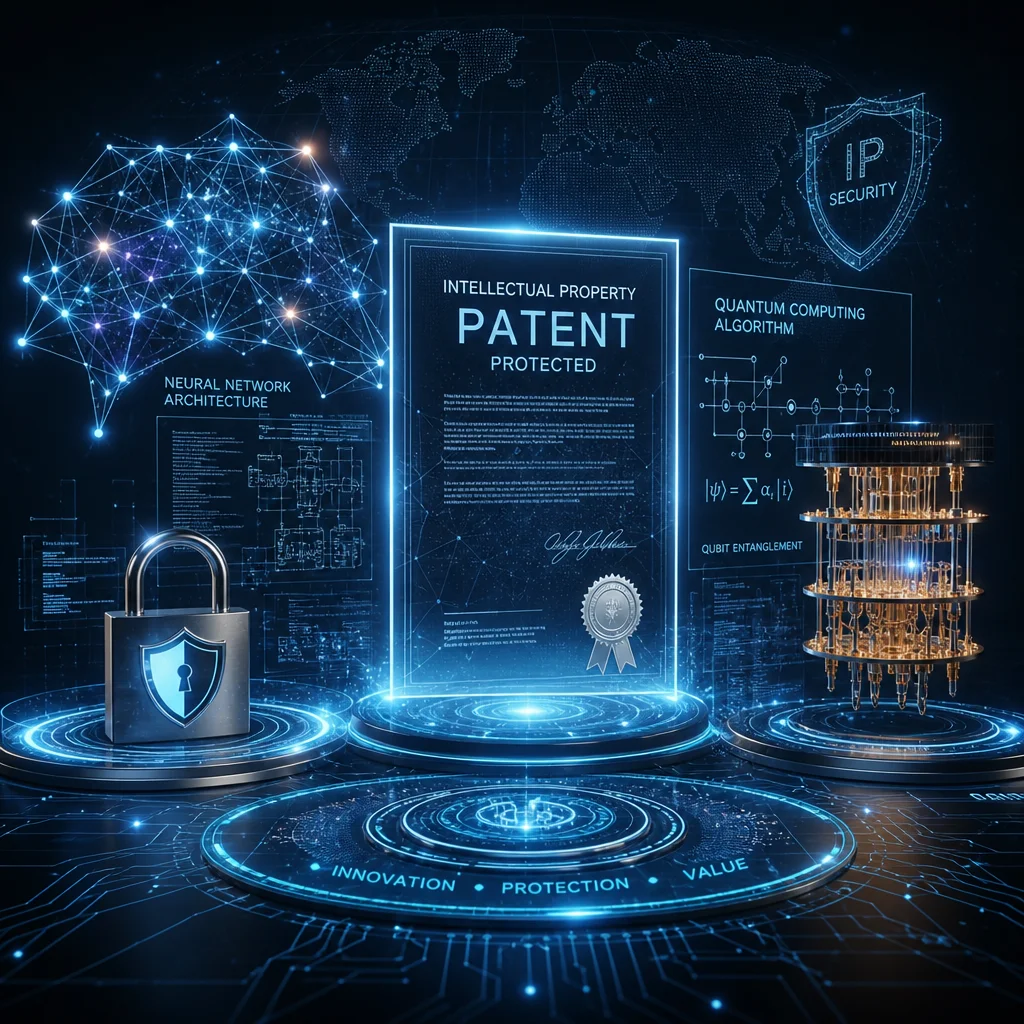
Emerging technologies consistently outpace the legal frameworks designed to govern them. Artificial intelligence, quantum computing, gene editing platforms, autonomous driving systems, and next-generation wireless communications challenge foundational doctrines that intellectual property law has relied upon for decades. Companies driving innovation in these sectors require far more than a basic filing schedule; they need a sophisticated operational strategy capable of navigating patent litigation when the core technology itself is still evolving.
Why emerging technologies strain the IP system
Traditional patent regimes were constructed for mechanical and chemical inventions. A physical apparatus possesses distinct boundaries: defined structural components, clear functional mechanisms, and repeatable manufacturing steps. Modern software rarely affords such clarity. A complex deep learning architecture can be expressed in mathematical equations, yet its true economic value resides within proprietary training corpora, hyperparameter configurations, and real-world deployment contexts. These intangible assets are notoriously difficult to claim and exceptionally rigorous to enforce within traditional courtrooms.
Three compounding dynamics exacerbate this friction. First, technological convergence means a single commercial product frequently fuses software algorithms, physical IoT sensors, radio frequency hardware, and biological components. Second, velocity dictates that product development cycles run in months while patent prosecution timelines stretch across years. Third, geographical reach ensures that a single alleged infringement triggers simultaneous disputes across multiple international jurisdictions, each enforcing divergent standards of patent eligibility.
Patent eligibility in software and AI
The most contentious debate in modern patent jurisprudence boils down to a fundamental query: does an invention cross the threshold from an abstract idea into protectable subject matter? Courts across the United States, the European Patent Office, and Asian jurisdictions utilize varying legal tests, yet they share a common requirement. Merely conceptualizing an algorithm is insufficient. Claims must delineate a concrete technical implementation that directly resolves a technical bottleneck.
For machine learning teams, this demands drafting claims centered on model architecture, training methodologies, deployment mechanics, or hardware integration. A patent application claiming broad software designed to forecast consumer behavior faces immediate vulnerability under abstraction rejections. Conversely, a claim detailing a specific method to minimize inference latency on edge devices by pruning weight matrices according to a predefined algorithmic schedule stands on firm legal ground. Identical principles govern data pipelines, sensor fusion arrays, and industrial control loops.
Practical drafting rules
- Anchor every patent claim in a tangible technical effect rather than an abstract business outcome.
- Explicitly describe the physical hardware topology or distributed network environment where the method executes.
- File early using provisional applications as a cost-effective mechanism to secure priority dates.
- Maintain immutable, timestamped inventive records mapping specific design decisions to named personnel.
Inventorship when machines contribute
Major patent offices globally have firmly rejected the proposition that an artificial intelligence system can be legally designated as an inventor. The human developer, researcher, or director who orchestrates the system remains the sole legal entity recognized for inventorship. While this principle appears settled, it introduces severe operational ambiguity. When five different engineers contribute to an automated pipeline, precisely who qualifies as a legal inventor? Furthermore, what transpires when a generative model autonomously produces a completely novel output that none of the creators anticipated?
Organizations mitigate these risks by instituting rigorous internal inventorship compliance policies, mandatory contribution disclosure logs, technical review committees, and contemporaneous lab journals. Patent litigation frequently pivots entirely upon the audit trail of these documents. An improperly designated inventor can invalidate an issuing patent years into its lifecycle, underscoring why meticulous diligence during the initial drafting phase outweighs sheer filing speed.
Standard-essential patents and connected devices
Global standards underpinning 5G, Wi-Fi 6, advanced video codecs, and the Internet of Things rely heavily on cooperative technology pooling. Entities contributing proprietary inventions to a standard commit to licensing those assets under fair, reasonable, and non-discriminatory terms. In commercial reality, the precise definition of reasonable serves as the ignition point for aggressive multi-jurisdictional litigation.
Licensing negotiations typically encompass sprawling enterprise patent portfolios rather than isolated claims. Hardware manufacturers frequently face coordinated demands from dozens of patent pools simultaneously, each asserting fractional ownership over a standard. Foreign courts have increasingly established global portfolio royalty rates that occasionally conflict with one another, creating severe legal uncertainty. For mid-sized device manufacturers, defending against these royalty demands can quickly eclipse the research and development expenditures of the underlying product.
Trade secrets versus patents in fast-moving fields
The core bargain of the patent system is an exchange: limited monopoly exclusivity traded in return for total public disclosure. In industrial sectors where commercial product lifecycles are markedly shorter than a twenty-year patent term, this exchange often fails to yield a net business advantage. A published patent application provides direct competitors with a precise blueprint of the innovation and its underlying mechanics. If an invention can be readily reverse-engineered or designed around, public disclosure effectively surrenders competitive superiority.
Consequently, trade secret protection offers an ideal mechanism for securing proprietary training datasets, neural network weight matrices, proprietary compilation parameters, and manufacturing know-how. The vulnerability of trade secrets lies in their longevity; protection evaporates the moment secrecy is breached, whether through corporate espionage or a departing employee walking away with unencrypted source code. Comprehensive access control tiers, automated audit logs, strict contractual non-disclosure agreements, and airtight offboarding protocols serve as essential structural safeguards.
Many market leaders deploy a hybrid strategy: they patent the highly visible architectural framework of a system while preserving proprietary fine-tuning procedures and internal data pipelines as strict trade secrets. This division must be deliberately architected during the active product development phase, long before a competitor launches a comparable offering.
Frontier fields: quantum and gene editing
Quantum computing introduces unprecedented layers of legal ambiguity. Core quantum algorithms frequently border on pure mathematics, rendering traditional patent eligibility difficult to establish. Hardware-level claims addressing physical qubit topologies, fault-tolerant error correction codes, and cryogenic control electronics offer vastly superior defensibility compared to abstract software claims. Furthermore, patent prosecution strategies in quantum technology require immense patience, given that broad commercial adoption remains years away.
Gene editing technologies present an entirely separate spectrum of legal complexities. Landmark patent battles surrounding CRISPR-Cas9 methodology have generated prolonged, highly capitalized disputes over priority of invention and global geographic rights. Licensing frameworks in this domain are further complicated by strict bioethical regulations, multi-tier governmental approvals, and intense public interest scrutiny. Enterprises operating within biotechnology must prepare for rigorous challenges attacking both the validity and the structural breadth of their claims.
Forum selection and cross-border litigation
Intellectual property rights are strictly territorial. A single foundational innovation frequently demands coordinated multi-country filings, and patent litigation can ignite in any jurisdiction where an infringing product enters the stream of commerce. Claimants actively target favorable judicial venues offering accelerated docket schedules, predictable procedural rules, and robust injunctive remedies. Conversely, defendants scour the global landscape for jurisdictions where they can swiftly mount invalidation challenges.
This dynamic precipitates complex parallel proceedings. Litigation unfolding in one country may adjudicate patent validity while a sister court evaluates financial damages in another. Litigants routinely seek emergency preliminary injunctions capable of halting customs shipments at international borders, recognizing that an import ban on a single integrated component can paralyze an entire hardware product line. While settlement remains common, it typically materializes only after years of exhaustive expenditure and operational distraction.
The role of non-practising entities
A significant segment of patent holders operates without manufacturing or selling commercial goods, functioning instead by acquiring portfolios for aggressive licensing campaigns. These non-practising entities are not inherently illegitimate; academic research institutions and independent inventors frequently license foundational technology without maintaining commercial production lines, representing a valid mechanism for monetizing R&D investments.
The economic equation shifts dramatically when a litigious entity asserts a patent covering an isolated functional feature embedded within a deeply complex multi-component product. Royalty demands calculated against the entire market value of the end device rather than the specific patented feature generate severe economic distortions. Courts and international legislative bodies have systematically responded by tightening rules governing damages apportionment, enforcing stricter pleading standards, and shifting legal costs in targeted jurisdictions. Enterprise defendants have simultaneously recognized that mounting aggressive early validity challenges provides a far more cost-effective defense than proceeding to trial.
Open source and defensive strategies
Modern software development relies heavily on open-source libraries, each governed by intricate license stipulations. Certain licenses enforce strict copyleft obligations, mandating the public disclosure of proprietary modifications if derivative software is distributed commercially. Other licenses remain permissive. Engineering teams that fail to audit open-source dependency compliance expose their organizations to intellectual property liabilities that can dwarf conventional patent disputes.
To establish a robust defensive posture, businesses utilize specialized mechanisms. Defensive publication effectively places technical disclosures into the public domain, legally blocking competitors from patenting identical iterations. Strategic cross-licensing agreements distribute litigation risk among industry incumbents, while patent pools streamline administrative access to standardized technology stacks. The optimal defensive mix depends entirely on an organization’s specific business model and market velocity.
A practical playbook
For executive leadership and technical founders, the ultimate objective is not merely winning adversarial litigation; it is proactively mitigating avoidable disputes and ensuring organizational readiness the moment a demand letter arrives.
- Map the competitive patent landscape thoroughly prior to product launch rather than reacting reactively after receiving notice.
- Conduct comprehensive freedom-to-operate reviews across each targeted commercial market utilizing specialized local counsel.
- Maintain rigorously timestamped, auditable invention disclosure logs subject to quarterly compliance reviews.
- Allocate dedicated corporate financial reserves for cross-border litigation as a standard operational cost of doing business globally.
- Initiate licensing negotiations proactively while commercial leverage is maximized and corporate relationships remain intact.
- Strictly govern corporate data flows: audit leaving proprietary models, training data, source code, and internal documentation.
Thorough documentation wins technical litigation. In complex patent disputes, judges and juries rely heavily on verifiable evidence: time-stamped design disclosures, consistent internal governance policies, and objective administrative logs. A disciplined compliance process exerts far more persuasion than clever legal arguments contrived on the courtroom floor.
The road ahead
Intellectual property management within emerging technology sectors is fundamentally an operational business discipline rather than an isolated legal formality. Legal frameworks will inevitably continue evolving as legislative bodies and courts struggle to keep pace with novel paradigms of human and machine innovation. Organizations that construct resilient, proactive IP compliance frameworks today will spend significantly less time defending themselves in court and vastly more time scaling commercial products. Competitive advantage firmly belongs to those enterprises that treat intellectual property as foundational infrastructure rather than an emergency corporate response.
“